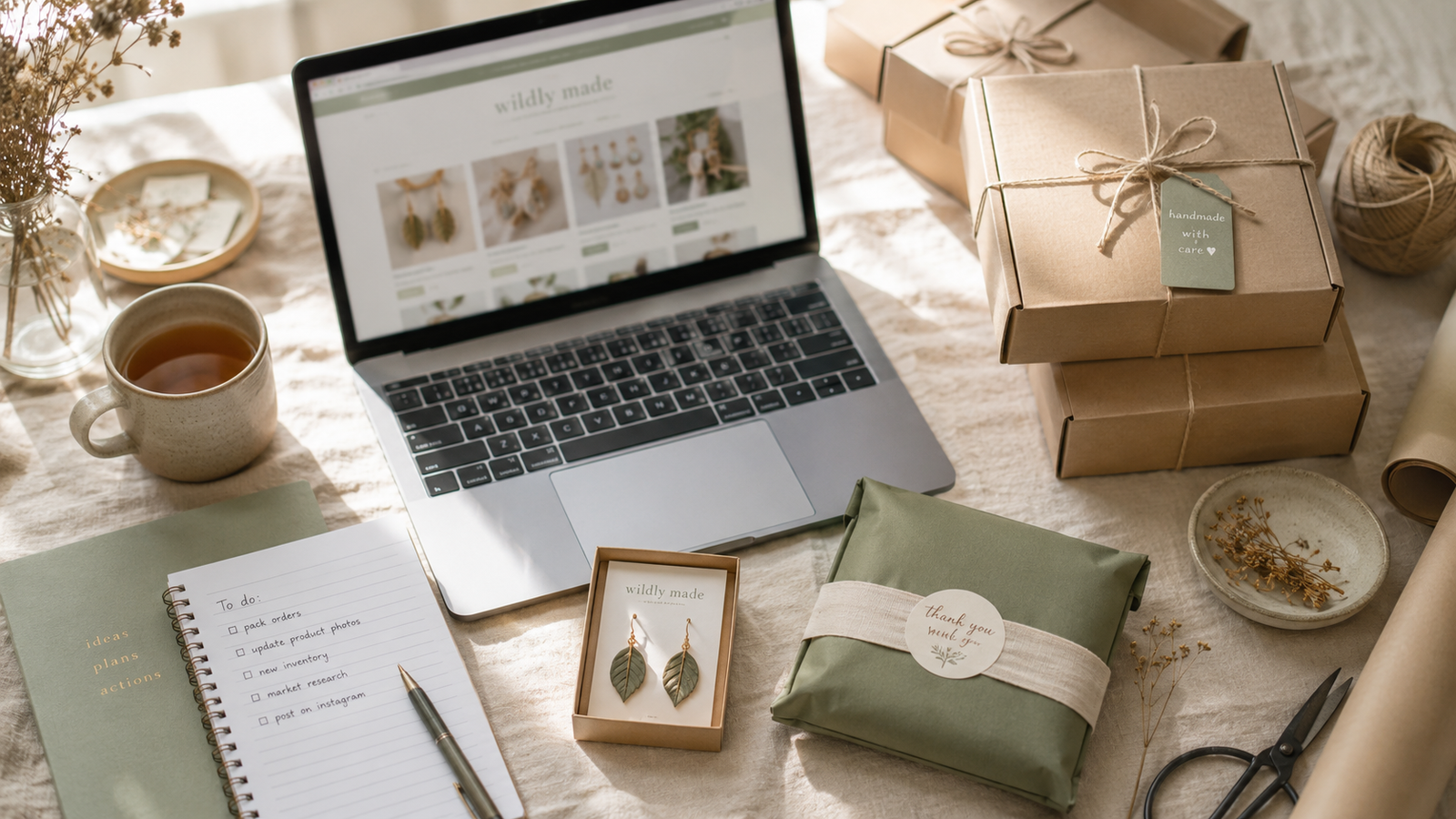
Etsy vs. Your Own Website: How to Know Which Is Right for Your Small Business
This blog is reader supported and contains affiliate links. These are at no cost to you and help to keep Her Money Her Methods running. Please know that I only share things I’d actually recommend to a friend.
If you sell handmade products, digital downloads, or anything creative, you’ve probably had this argument with yourself at 11pm: “Should I just stay on Etsy, or is it finally time to build my own website?”
I’ve sold both ways: through marketplaces and through my own site, and I can tell you the honest answer up front: neither one is “better.” They’re better at different stages, for different businesses. The trick is knowing which stage you’re in.
So instead of another “Etsy vs. website” pros-and-cons list, let’s do this like a decision, because that’s what it actually is.
What Etsy Is Actually Selling You
Etsy’s real product isn’t the shop tools. It’s the foot traffic. Millions of buyers are already there, credit cards in hand, searching for exactly the kind of things you make. When you open an Etsy shop, you’re renting a booth in the world’s busiest craft fair.
That’s genuinely valuable when:
- You’re brand new and testing an idea. You can be live in an afternoon, with zero tech skills, and find out whether strangers will pay for your product. That feedback is worth more than any business plan.
- You don’t have an audience yet. No email list, no social following, no traffic of your own? Etsy’s search engine is doing your marketing for you.
- Your products are impulse-friendly. Lower price points, giftable items, and trend-driven products thrive in a browsing marketplace.
But the booth rental comes with real costs, and not just the listing fees and transaction fees (which quietly add up to a meaningful slice of every sale). The bigger costs are the invisible ones:
- You don’t own the customer relationship. Etsy considers them their customers. You can’t email them, retarget them, or build loyalty on your terms.
- You’re one policy change away from disruption. Fee increases, algorithm shifts, and account suspensions to name a few. Sellers live with a landlord who can renovate whenever they want.
- You’re a search result, not a brand. Your listing sits next to twelve competitors, some of whom will undercut you. Price-shopping is built into the experience.
What Your Own Website Is Actually Selling You
Your own website’s product is ownership. Your customer list. Your brand experience. Your pricing power. Nobody’s ads next to your products, nobody’s fees changing under you, nobody’s algorithm deciding whether you get seen.
A website of your own wins when:
- You have (or are building) your own traffic. An email list, a Pinterest presence, an Instagram following, blog readers…any audience you can send to a link means you no longer need to rent Etsy’s foot traffic.
- Repeat customers matter to your business. If people come back to buy again, or would if you could reach them, owning the relationship is worth real money. Email marketing to past customers is some of the highest-return effort in small business.
- You’re charging premium prices. Marketplace shoppers compare and bargain-hunt. On your own site, you control the story, the photography and the experience. Premium pricing survives when it isn’t sitting next to a cheaper lookalike.
- You want to grow beyond products. A website can hold your blog, your email signups, your digital products, your story. Etsy holds your listings.
The trade-off? You are now responsible for your own traffic. This is the part nobody says loudly enough: the day you launch your own site, exactly nobody visits it. Every visitor has to come from marketing you do: SEO, Pinterest, email, social. A beautiful website with no traffic earns less than a mediocre Etsy shop with marketplace search behind it.
The Real Question: Where Does Your Traffic Come From?
Strip away everything else, and the decision comes down to one honest question:
“If Etsy disappeared tomorrow, could my customers find me?”
- If the answer is no — Etsy’s search is your business right now. Stay, sell, and use this season to build assets you own: start the email list, build the Pinterest boards, post consistently. You’re not “behind” for being on Etsy. You’re gathering strength.
- If the answer is “actually, yes” — you have followers, subscribers, or search traffic of your own — then Etsy’s fees are buying you foot traffic you no longer need, and it’s time to build your own home base.
- If the answer is “partly” — welcome to the hybrid stage, which is where many smart sellers live for a while: keep Etsy running for discovery, launch your own site for your existing audience, and gently train your people to buy direct (where your margins are better and the relationship is yours).
Signs It’s Time to Move to Your Own Website
If three or more of these are true, you’re ready:
- Repeat customers are a meaningful share of your sales
- You have an email list or social following you could send to a link today
- Your price point is above the marketplace’s impulse-buy range
- Etsy fees on your monthly sales have started to genuinely sting
- You want to sell things Etsy isn’t built for: digital products, services, bundles, subscriptions
- You’re tired of building equity in someone else’s platform
If You’re Building Your Own Site: Start with Shopify
When it’s time for your own store, my top recommendation for anyone selling products is Shopify, and I don’t say that lightly, because the website-builder world is full of options and I have tried many of them.
Here’s why Shopify wins for ecommerce specifically:
- It’s built to sell, not just to look pretty. Checkout, inventory, shipping labels, taxes, abandoned-cart emails…the unglamorous machinery of an actual store is native, not bolted on.
- You can start simple and never outgrow it. The same platform runs a first-month shop with six products and multimillion-dollar brands. You’ll never face a painful “we outgrew our website” migration.
- No tech skills required. If you can use Canva, you can build a Shopify store. Templates are polished out of the box, and you’re live in a weekend.
- It plays well with everything. Email platforms, Pinterest, Instagram Shopping, print-on-demand services — whatever your business plugs into, Shopify connects to it.
You can try Shopify free here and build your store before paying anything, which, fittingly, is the same advice as everything else in this post: test before you commit.
Final Thoughts
Etsy isn’t a trap, and your own website isn’t a graduation ceremony. They’re tools for different jobs: Etsy rents you customers; your own website lets you keep them.
Start where the traffic is. Build what you own on the side. And when your own audience can sustain you, that is when you move home.
You don’t have to have it all figured out today. You just have to know which stage you’re in, and take the next step from there.
I am not a licensed financial advisor. Everything on Her Money Her Methods is for educational and informational purposes only. Always do your own research and consult a qualified professional before making business and financial decisions.